Cronjob
Cron job scheduler service for webtrees


A cron job scheduler service for webtrees: schedule maintenance/batch jobs with standard cron expressions, watch their run history in the admin UI, and trigger them manually. The module is the service; the OS (classic cron or a systemd timer) only has to call one small script once per minute.
- Job registry + run history in two own tables (
cj_job, cj_run) - Admin UI (control panel): job list, create/edit form, run history, run now, enable/disable, delete
- Isolated execution: every job runs as a separate child PHP process (
proc_open, no shell), with per-job timeout and captured output - Self-registration: other modules can advertise their jobs (a
cron-jobs.php
manifest or a getCronJobs() method); they appear here, created disabled and ready to enable - Event-driven jobs: jobs can fire on events instead of a schedule — queued by a token-protected webhook, by a direct
EventQueue::push() call from other modules, by the built-in pseudo-event pollers, or by route events - Failure notification: per-job opt-in to alert the site’s administrator accounts when a job fails
- Offline awareness: while
data/offline.txt exists the tick is skipped before any database access - No core changes, no changes to other modules
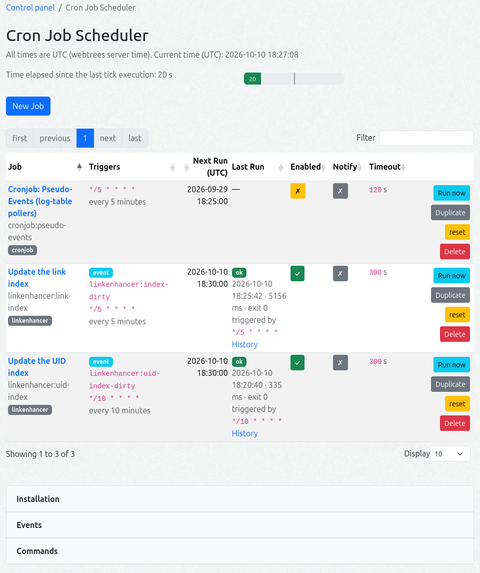
It was originally developed as a support module for LinkEnhancer to keep its indexes up to date.
Support
1 - Setup
Installation and requirements
What do we need to install this module and how to set it up correctly.
1.1 - Requirements
System requirements for the Cronjob module
- webtrees 2.2.x (PHP 8.3+)
- PHP CLI with
proc_open available (standard) - A trigger: classic cron, a systemd timer, a Windows Task Scheduler task, or the built-in watch daemon (no OS timer needed — see “Trigger installation”)
1.2 - Installation
Step-by-step installation and trigger setup
- Copy the module folder to
modules_v4/cronjob/ (ZIP install works too). The cron library ships inside the module — nothing to fetch. - Open webtrees once (any page as an admin) so the module’s
boot() creates its tables. - Install the trigger (classic cron, systemd timer, or Windows Task Scheduler — the module’s admin page generates the block for your OS with the paths of this installation already filled in).
- Trigger installation (once) — see below.
- Create your first job in the admin UI or configure and activate registered jobs.
Trigger installation (once)
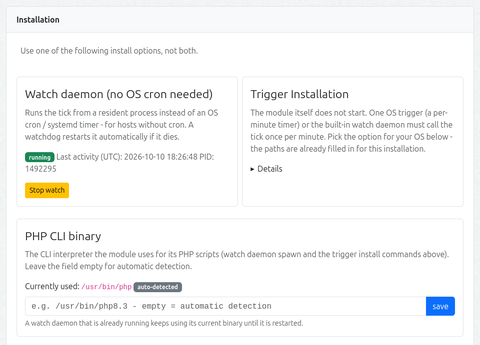
Important — PHP CLI binary: the admin page’s Installation accordion shows which PHP CLI interpreter is currently resolved (badge: auto-detected / manual path) and lets you pin a manual path. The chosen binary is used for the watch daemon spawn and in all generated trigger commands.
It is important to check whether your web server provides a PHP-CLI binary (SAPI) and whether the module is configured correctly to use it. Otherwise, tick will not work.
The tick is designed to run every 60 seconds. It makes an inventory of cron jobs, commands and events, triggers events and processes the task queue.
Pick one of the options shown in the module’s admin page:
Option A — classic cron
One line in the web server user’s crontab, runs every minute:
* * * * * cd "/path/to/webtrees" && mkdir -p data/cronjob && "/usr/bin/php" modules_v4/cronjob/cli/tick.php cron:tick >> "/path/to/webtrees/data/cronjob/tick.log" 2>&1
Option B — systemd timer
Two unit files (also shown in the admin page):
# /etc/systemd/system/cronjob-tick.service
[Unit]
Description=webtrees cronjob module tick (runs due maintenance jobs)

[Service]
Type=oneshot
User=<webserver-user>
WorkingDirectory="/path/to/webtrees"
ExecStart="/usr/bin/php" ./modules_v4/cronjob/cli/tick.php cron:tick
# /etc/systemd/system/cronjob-tick.timer
[Unit]
Description=Run the webtrees cronjob tick every minute

[Timer]
OnBootSec=1min
OnCalendar=*:*:00
Persistent=true

[Install]
WantedBy=timers.target
sudo systemctl daemon-reload
sudo systemctl enable --now cronjob-tick.timer
Option C — watch daemon (no OS timer)
Click Start watch on the admin page. A resident process runs the tick every 60 seconds, and a page-load watchdog respawns it if it dies. Use it when the host has no cron and no systemd access, or for testing — on Windows hosts this is the simplest option.
stateDiagram-v2
    [*] --> Stopped: (initial)
    Stopped --> Running: Start watch (Admin-UI)
    Running --> TickLoop: tick every 60 s
    TickLoop --> TickLoop: run job
    TickLoop --> Dead: ⚠ process dies
    Dead --> Running: 🔄 Watchdog respawn<br/>(next page load<br/>Cooldown 5 min)
    Running --> Stopped: Stop watch
    Dead --> Stopped: Stop watch<br/>(no respawn)

    note right of Running
        🔒 holds data/cronjob/watch.lock
        🆔 PID visible in Admin-UI
        🛡 survives FPM-Worker-Recycle (setsid)
    end note
Option D — Windows Task Scheduler
The admin page generates the XML with paths already filled in. Save it as wt-cronjob-tick.xml (UTF-8) and run schtasks /Create /F /XML wt-cronjob-tick.xml once in an elevated prompt.
1.3 - Admin settings
Webtrees module settings
Since this is a service module, the only way to access its functions is through the module settings page. Strictly speaking, the only settings available are:
- the optional path to the PHP CLI binary (if it is not automatically detected) and
- the option to enable additional debug logging in the error log.
Event catalog
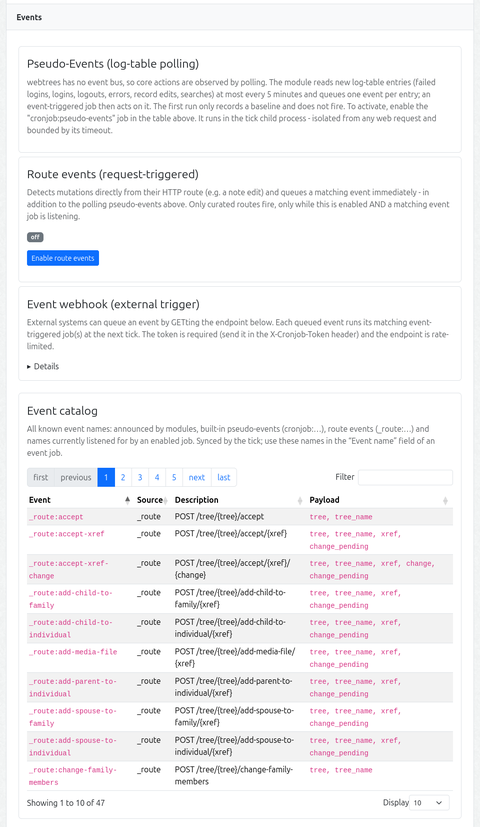
The admin page (Events section) and the job form’s event-name suggestions are fed by an event inventory (cj_event_catalog, synced by the tick like the job registry). It merges, in this priority order:
- events announced by modules (manifest
events section / getModuleEvents()), namespaced <module>:<name> - built-in pseudo-events (
cronjob:*, from the detectors) - route events (
_route:*, derived from the live route table) - event names currently listened for by an enabled event job (source
listening) — this covers webhook-only names
Each entry carries its source, a description (stored as a translation key, translated at render time only) and the known payload parameter names. For route events the payload is derived from the route path: the {param} placeholders in the order they appear, with {tree} expanding to tree + tree_name (mirroring what the live event payload carries). For pseudo-events both come from the detector (description() / payloadKeys()). The full list is also what the “Event name” datalist in the job form offers. The catalog is rendered as a client-side DataTables (sort/filter/paging) in the Events section.
Command catalog
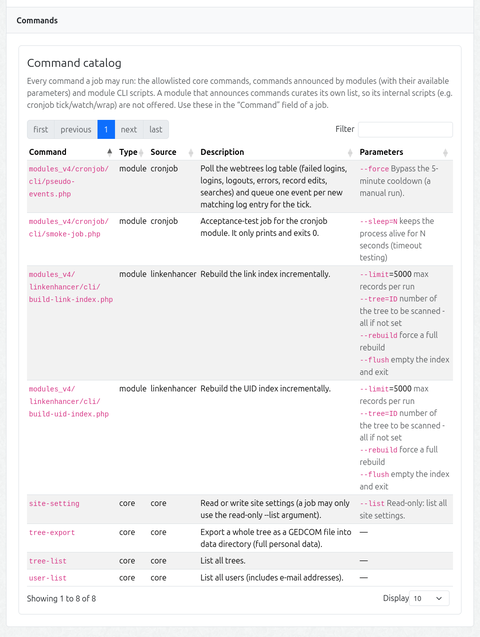
The job form’s command suggestions and the admin page (Events section) are fed by a command inventory (cj_command_catalog, synced by the tick like the others). It merges, in this priority order (first source wins per command):
- the allowlisted core commands (
tree-export, tree-list, user-list, site-setting), with their known parameters - commands announced by modules (manifest
commands section / getModuleCommands()) — with a description and structured parameters - module CLI scripts found by glob (
modules_v4/<module>/cli/*.php), except for a module that announced commands (that module curates its own list, so its internal scripts are not offered)
Each entry carries its type (module / core), its source, a description (translation key, translated at render time) and the available parameters (structured: name, optional, default, description). In the job form, entering a command that matches an announced command shows its parameters as a hint under the field.
Failure notification
A job can be marked Notify on failure. When such a job fails (non-zero exit or timeout), the site’s administrator accounts are alerted through webtrees’ own MessageService::deliverMessage() — which delivers via the internal message system and/or e-mail according to each recipient’s own contact-method preference. No addresses are stored in the module and no channel is hardcoded: the recipients are the admin user accounts, and how they are reached follows the site’s messaging settings.
The notification carries the job name, status, exit code, duration and a short tail of the captured output. It runs in the tick (no web request), so it carries no link beyond the text. A notification problem never breaks the tick.
2 - Usage
Creating jobs, run history, and the admin UI
Creating a job
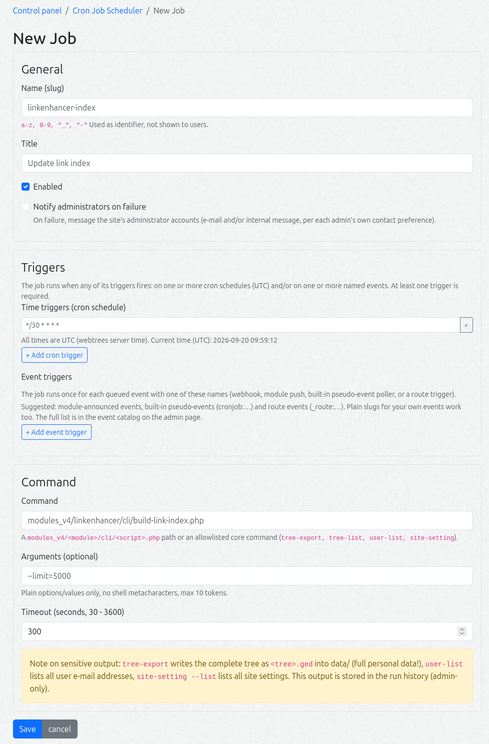
Control panel → Cron Job Scheduler → New Job:
| Field | Meaning |
|---|
| Name (slug) | technical identifier, a-z 0-9 _ -. Read-only for module-offered jobs (their <module>:<name> key is fixed); editable for jobs you create yourself. |
| Title | human readable name |
| Triggers | one or more time triggers (cron schedules) and/or event triggers — the job fires when any trigger fires. At least one is required. |
| Cron expression | (time trigger) standard 5-field cron or a macro (@daily, @weekly, …). Times are UTC. |
| Event name | (event trigger) the event this job reacts to. Slug or <domain>:slug, max 64 chars. |
| Command | a modules_v4/<module>/cli/<script>.php path or an allowlisted core command. |
| Arguments | plain options/values only (e.g. --limit=5000), max 10 tokens |
| Timeout | 30 - 3600 s |
| Notify on failure | opt-in: alert the administrator accounts when this job fails |
Available event names and commands are provided as datalists to make data entry easier.
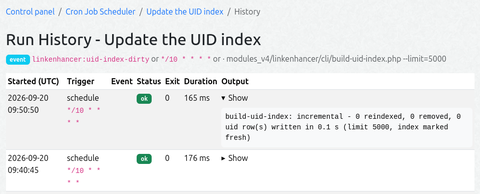
The Run now button queues the job for the next tick (≤ 60 s). The History page shows status, exit code, duration, the trigger that fired the run, and the captured output (last 64 KB) of the last 25 runs per job (plus a 30-day global retention window).
The job table is a client-side DataTable (search box, sortable columns, paging, state saved in the browser). The Enabled and Notify columns can be toggled in place. Per row: Duplicate (opens the create form prefilled) and Reset (restores module-offered defaults).
3 - The Tick
How the once-a-minute tick schedules and runs jobs
The tick is the heart of the module: once a minute it looks at every enabled job, decides what is due, and runs it. Neither the webtrees core nor the operating system does any scheduling itself — they only start tick.php
.
flowchart TD
    subgraph Triggers["`⏱ Triggers *(once per minute)*`"]
        CRON["`🕑 OS cron / systemd<br/>*every minute*`"]
        WATCH["`👁 watch daemon<br/>*(in-module)*`"]
    end

    subgraph Guard["🛡 Guard"]
        TP["`📄 cli/tick.php · **cron:tick**<br/>*guard(): 403 over HTTP*`"]
        OFF{"`⚠ site offline?<br/>*data/offline.txt*`"}
        BOOT["`🚀 boot()<br/>*webtrees + DB*`"]
    end

    subgraph Selection["🔎 Select work"]
        TIME["`📅 time-based jobs<br/>**next_run_at due** *(UTC)*`"]
        CE[("`📦 cj_event<br/>*event queue*`")]
        DRAIN["`🧮 drain queue<br/>*coalesced · 60 s budget*`"]
    end

    subgraph Execution["`⚙ Execution *(isolated child)*`"]
        RUN["`🧪 JobRunner<br/>**proc_open**`"]
        LIM["`⏲ timeout 30–3600 s<br/>last **64 KB** · exit code`"]
    end

    subgraph Storage["💾 Storage"]
        CJRUN[("`cj_run<br/>*run history*`")]
        MARK["`🏷 tick.last<br/>*stale > 300 s → tick_stale*`"]
    end

    CRON --> Guard
    WATCH --> Guard
    TP --> OFF
    OFF -->|"offline"| SKIP["⏭ skip tick"]
    OFF -->|"online"| BOOT
    BOOT --> TIME
    BOOT --> DRAIN
    CE --> DRAIN
    TIME --> Execution
    DRAIN --> Execution
    RUN --> LIM
    LIM --> CJRUN
    BOOT --> MARK

    classDef sourceStyle fill:#e3f2fd,stroke:#1565C0,stroke-width:2px
    classDef queueStyle fill:#fff3e0,stroke:#E65100,stroke-width:2px
    classDef tickStyle fill:#e8f5e9,stroke:#2E7D32,stroke-width:2px
    classDef execStyle fill:#fce4ec,stroke:#C2185B,stroke-width:2px
    classDef storageStyle fill:#f5f5f5,stroke:#616161,stroke-width:1px

    class CRON,WATCH sourceStyle
    class OFF,CE queueStyle
    class TP,TIME,DRAIN tickStyle
    class RUN,LIM execStyle
    class CJRUN,MARK,SKIP storageStyle
What starts a tick
Pick one trigger (once):
- OS cron —
* * * * * from the webtrees root (see Installation). - systemd timer — the generated unit from the module’s admin page.
- watch daemon — the in-module resident process that re-launches
tick.php
every 60 s and survives FPM worker recycling (Installation, which also carries the daemon’s lifecycle diagram).
All three run the same command: php modules_v4/cronjob/cli/tick.php cron:tick.
What one tick does
- Guard —
CliBootstrap::guard() answers 403 if the script is ever reached over HTTP; then CliBootstrap::boot() loads webtrees + the database. - Offline check — if
data/offline.txt exists the tick is skipped entirely, before any database access — e.g. during a webtrees update, when schema and code are in flux. - Select the work — two sources, combined in one pass:
- time-based jobs whose
next_run_at has passed (cron schedules, UTC); the due triggers are computed against the last run (or the job’s creation, for never-run jobs). - event jobs — the
cj_event queue is drained oldest-first, coalesced to one run per event name, within a 60-second wall-clock budget. Event jobs receive the event name and payload via the CRONJOB_EVENT / CRONJOB_EVENT_PAYLOAD environment. See the event pipeline.
- Run each job in isolation —
JobRunner validates the command (a modules_v4/<module>/cli/<script>.php path, or one of the four allowlisted core commands; at most 10 argument tokens) and launches it as a child process with a hard timeout (30–3600 s). Only the last 64 KB of output are captured; a job that hits its timeout is killed (proc_terminate) and reported as exit -9. - Record — every run is written to
cj_run (status, exit code, duration, the trigger that fired it, captured output) — this is the run history. Event-triggered runs are additionally linked via cj_event_run. - Marker — the tick writes
data/cronjob/tick.last. If that marker is older than 300 s, the module reports itself as tick_stale in the admin status.
Manual runs
You can also run the tick by hand for debugging — --dry-run, --job=<name>, --strict and --full-output are described on the CLI scripts page. Note that --full-output may expose personal data, so only use it where the output destination is trusted.
4 - Events
Event-driven jobs, webhooks, pseudo-events, and route events
flowchart TD
    subgraph Sources["📡 Event Sources"]
        WH["`🔗 Webhook<br/>**GET + Token**`"]
        DC["`📞 Direct Call<br/>**EventQueue::push**`"]
        PE["📋 Pseudo-Events<br/>Log table poller"]
        RE["🔀 Route-Events<br/>POST on mutating routes"]
    end

    subgraph Queue["⏳ Queue"]
        CE[("`📦 cj_event<br/>**DB Queue**`")]
    end

    subgraph Tick["`⏱ Tick *(every 60 s)*`"]
        MATCH["Match events<br/>coalesced: 1 per name"]
        BUDGET["`⏲ **60 s** wall-clock budget`"]
    end

    subgraph Execution["⚙ Execution"]
        JOB["`Job script<br/>child process via **proc_open**`"]
        ENV["🌐 CRONJOB_EVENT<br/>CRONJOB_EVENT_PAYLOAD"]
    end

    subgraph Storage["💾 Storage"]
        RUN[("cj_run<br/>run history")]
        ER[("cj_event_run<br/>link")]
    end

    WH --> Queue
    DC --> Queue
    PE --> Queue
    RE --> Queue
    CE --> Tick
    MATCH --> BUDGET
    BUDGET --> JOB
    JOB --> ENV
    JOB --> RUN
    JOB --> ER

    classDef sourceStyle fill:#e3f2fd,stroke:#1565C0,stroke-width:2px
    classDef queueStyle fill:#fff3e0,stroke:#E65100,stroke-width:2px
    classDef tickStyle fill:#e8f5e9,stroke:#2E7D32,stroke-width:2px
    classDef execStyle fill:#fce4ec,stroke:#C2185B,stroke-width:2px
    classDef storageStyle fill:#f5f5f5,stroke:#616161,stroke-width:1px

    class WH,DC,PE,RE sourceStyle
    class CE queueStyle
    class MATCH,BUDGET tickStyle
    class JOB,ENV execStyle
    class RUN,ER storageStyle
Besides time-based schedules, a job can be triggered by an event. webtrees has no event system, so events are plain DB rows (a small cj_event queue) that the tick drains once a minute. An event-triggered job runs for a queued event whose name matches its Event name — coalesced: per tick at most the newest event of each name is drained (one run per name per tick), and the name’s older pending duplicates are dropped — a burst of identical events never queues a burst of job runs (job scripts are idempotent/incremental by convention).
Naming scheme (analogous to job names). Event names are slugs (a-z 0-9 _ -, max 64 chars total), optionally namespaced <domain>:<slug>:
| Form | Meaning |
|---|
plain slug (e.g. index-dirty) | your own events — webhook or direct EventQueue::push() |
cronjob:<slug> | built-in pseudo-events (log-table pollers) |
_route:<slug> | route-triggered events (see below) |
<module>:<slug> | events announced by a module (see “Announcing events”) |
Queuing an event has four sources:
- Webhook (external systems). GET the endpoint shown in the admin page (section “Event webhook”):
GET /module/_cronjob_/Event?event=<name>&data=<json> with the token in the X-Cronjob-Token header. data is an optional JSON object, stored with the event. The endpoint requires the token, is rate-limited (20/min per site), and only accepts events while the module is enabled. It is a GET, not a POST: webtrees rejects POSTs without a session CSRF token, which an external caller cannot send. - Direct call (your own modules). From PHP code in another module:
\Schwendinger\Webtrees\Module\Cronjob\Services\EventQueue::push('index-dirty', ['tree' => 'X']); — this requires the cronjob module to be installed; guard it with class_exists('Schwendinger\Webtrees\Module\Cronjob\Services\EventQueue'). - Pseudo-events (built-in pollers). webtrees has no event bus, so core actions (logins, failed logins, logouts, record edits, errors, searches) are observed by polling the webtrees log table. Enable the offered
cronjob:pseudo-events job and the module reads the new log entries at most every 5 minutes, queueing one event per entry. - Route events (built-in, request-triggered). A curated set of mutating editor routes under
/tree/{tree}/ (record-specific routes with {xref} in the path, plus a small tree-level allowlist) queues its event immediately, right inside the request that made the change.
The tick matches each pending event against the enabled jobs that carry an event trigger for that name (a job can have several event triggers, or none at all), runs them, then marks the event handled (consumed once — even on failure, so a failing job does not re-run the same event forever). The drain is bounded: it takes the newest event per name (coalescing, see above) and stops after a 60 s wall-clock budget, so a saturated queue cannot starve the rest of the tick — the remaining events simply continue with the next tick. Every consuming run is additionally linked to the event in the cj_event_run cross table (an event can trigger several jobs), and the run history shows which event triggered a run. Handled events are purged after 7 days (their cj_event_run links are removed by the FK cascade); events with no matching job are discarded so the queue does not grow.
Event payload in the child process. Event runs hand the event to the job script via the process environment (the argv is reserved for the job’s static, strictly validated arguments):
| Variable | Set when | Value |
|---|
CRONJOB_EVENT | every event run | the event name (doubles as the “this is an event run” marker) |
CRONJOB_EVENT_PAYLOAD | event run with a non-empty payload | the event payload as JSON (route parameters, log-table entries, webhook data) |
$event   = getenv('CRONJOB_EVENT');                       // false on schedule / manual runs
$payload = json_decode((string) getenv('CRONJOB_EVENT_PAYLOAD'), true) ?: [];
$xref    = $payload['xref'] ?? '';                        // e.g. from a _route:* event
- Variable absent = no payload. The payload is truncated to 4000 bytes when the event is queued; a JSON cut mid-way no longer decodes, in which case
CRONJOB_EVENT_PAYLOAD is not set at all (never empty, never broken JSON). - Treat the payload as untrusted input — above all for webhook
data, whose sender is external. Validate values (xrefs, names, …) before using them. - The payload is independent of the command type: module CLI scripts and core commands (which simply ignore the variables) both work on event runs.
- The payload is also visible in the run history (event detail), independent of the child process.
4.1 - Pseudo-events
log-table polling
webtrees has no event bus, so core actions (logins, failed logins, logouts, record edits, errors, searches) are detected by polling the webtrees log table (app/Log.php, table log) and firing an event per new matching log entry. It is off by default: nothing runs until you enable the offered cronjob:pseudo-events job.
Built-in events (one cj_event per new log row, payload = the row):
| Event | Log filter (log_type, message prefix) | Fires when |
|---|
cronjob:log-auth-failed | auth, Login failed | a login attempt failed (wrong password, unknown user, unverified, not approved, no session cookies) |
cronjob:log-auth-login | auth, Login: | a user logged in |
cronjob:log-auth-logout | auth, Logout: | a user logged out |
cronjob:log-error | error, – | an exception was caught and logged (the message is the trace) |
cronjob:log-edit-update | edit, Update: | a record was updated (GedcomRecord::updateRecord()) |
cronjob:log-edit-delete | edit, Delete: | a record was deleted (GedcomRecord::deleteRecord()) |
cronjob:log-search | search, – | a search ran (one log row per searched tree) |
Payload: log_id, log_time, log_message (truncated to 250 characters, UTF-8-safe) plus gedcom_id / user_id when the log row carries them. The message prefixes are the hard-coded English strings of the current core; a core update that changes them silently stops the matching event (no fallback by design) — the event catalog descriptions and the test-pseudo-events suite pin the current mapping.
How it runs
- One trigger, one cooldown. Detection runs only from the offered
cronjob:pseudo-events job (*/5 * * * * by default), in the tick’s child process — isolated from any web request and bounded by the job’s timeout, so a heavy detector can never block or slow down a page load. A 5-minute cooldown (a data/ mtime marker) plus a lock keep repeated runs cheap and idempotent; the cooldown also caps a more frequent job cron. - Enabled by the job, gated per event. Enabling the
cronjob:pseudo-events job turns detection on (there is no separate switch — the tick only runs enabled jobs). A detector whose event no enabled event-triggered job listens for is skipped entirely — no query, no push. - Checkpoint + backpressure. Each detector remembers the highest
log_id it processed (state file). At most 200 rows are fired per run per detector; the checkpoint advances only as far as the last fired row, so a flood is drained over several runs — no data loss, only latency. - Baseline on first run. The first detection only records the current max
log_id and fires nothing, so enabling the job does not retroactively fire on existing data. (Re-listening to a previously unlistened event catches up its backlog, capped as above.) - Reset, not re-fire, on table shrink. If the table shrank below a checkpoint (TRUNCATE / DB restore — plain row deletions cannot do this, MySQL auto-increment continues after deletes), the detector re-baselines silently.
- Offline-safe & isolated. Skipped while
data/offline.txt exists; a broken detector never breaks the others; detection is serialized (flock) and state is persisted atomically to data/cronjob/pseudo-events.json.
The log table is the source of truth: under a flood the tick’s coalescing runs a job once per event name per tick with the newest payload — older rows are not re-delivered, but they stay in the log table, and log_id in the payload lets a job that needs completeness re-read the range itself.
If an event name vanishes, the admin table flags such triggers with the unknown event badge.
Detected events go into the same cj_event queue as webhooks and are consumed by the tick’s normal event drain. To act on one, create an event-triggered job whose Event name matches (e.g. alert on cronjob:log-auth-failed, re-index on cronjob:log-edit-update).
4.2 - Route events
request-triggered
A complementary, immediate detection mechanism: instead of polling state on a schedule, the module observes the HTTP request itself. When a request to a mapped mutating route has been handled successfully (2xx/3xx), it queues the matching event into the same cj_event queue — a listening event job then reacts at the next tick (~60 s), with no polling latency.
Which routes are mapped — two rules, both derived from the live webtrees route table. Common prerequisites: path starts with /tree/{tree}/, the handler is in webtrees’ request-handler namespace (RequestHandlers in 2.2.6, Controllers in 2.3), and the request is a POST mutation. In 2.2.6 this is enforced at map time (GET page routes are not mapped); in 2.3 the route carries no HTTP method, so the POST check happens at fire-time and the GET form-load of the same route is ignored.
- Record routes (rule-based — core updates are picked up automatically): the path contains
{xref} (the target record) and the handler class name starts with Edit, Delete, Add, Create, Link, Paste, Reorder or Pending. The event name is the third path segment, namespaced _route:<segment>; when several mapped routes share a segment (delete, edit-raw, accept, reject), the following path parameters are appended, hyphen-separated. - Tree-level routes (small curated allowlist): the significant tree-wide mutations that carry no
{xref} in the URL (import, merge, renumber, …). Each allowlist entry has an explicit event name. New tree-wide mutations in a core update need a module update (the record-route rule stays fully automatic).
| Event | Route (under /tree/{tree}/) | Payload |
|---|
_route:edit-note-object | POST edit-note-object/{xref} | tree, xref |
_route:update-record | POST update-record/{xref} | tree, xref |
_route:update-fact | POST update-fact/{xref}{/fact_id} | tree, xref (, fact_id) |
_route:delete-xref / _route:delete-xref-fact_id | POST delete/{xref}{/fact_id} | tree, xref (, fact_id) |
_route:edit-raw-xref / _route:edit-raw-xref-fact_id | POST edit-raw/{xref}{/fact_id} | tree, xref (, fact_id) |
_route:add-child-to-family, _route:add-spouse-to-family, _route:add-media-file | POST add-…/{xref} | tree, xref |
_route:add-child-to-individual, _route:add-parent-to-individual, _route:add-spouse-to-individual | POST add-…/{xref} | tree, xref |
_route:paste-fact | POST paste-fact/{xref} | tree, xref |
_route:link-media-to-record | POST link-media-to-record/{xref} | tree, xref — the media object; the target record is a form field, not in the URL |
_route:link-child-to-family, _route:link-spouse-to-individual | POST link-…/{xref} | tree, xref |
_route:reorder-children, _route:reorder-spouses, _route:reorder-media, _route:reorder-media-files, _route:reorder-names | POST reorder-…/{xref} | tree, xref |
_route:accept-xref / _route:accept-xref-change | POST accept/{xref}{/change} | tree, xref (, change) |
_route:reject-xref / _route:reject-xref-change | POST reject/{xref}{/change} | tree, xref (, change) |
_route:import | POST import | tree |
_route:load | POST load | tree — the chunked import continuation fires once per chunk |
_route:merge-step1 / _route:merge-step2 | POST merge-step1 / merge-step2 | tree |
_route:search-replace | POST search-replace | tree |
_route:renumber | POST renumber | tree |
_route:data-fix-update / _route:data-fix-update-all | POST data-fix/{data_fix}/update[-all] | tree, data_fix |
_route:accept / _route:reject | POST accept / reject (bulk) | tree |
_route:change-family-members | POST change-family-members | tree — the family xref is a form field |
In total 38 events (27 record routes + 11 tree-level routes). The payload always contains tree (id) + tree_name plus all matched route parameters. Record routes (with {xref}) additionally carry change_pending (bool): whether the change is still pending in the change table after this request (the user’s auto-accept preference is off) or already applied (auto-accept on). A pending change is applied when an admin accepts it — which fires its own _route:accept* events. Tree-level routes write directly (no change rows) and carry no such flag.
Breaking change (this version). Record routes without {xref} in the URL — all _route:create-* events plus _route:add-unlinked-individual — are no longer mapped: they carry no target record. Jobs listening to those events will never fire again; the admin table flags such triggers with an unknown route event badge (a generic check over all jobs’ _route:* triggers against the live map), so re-pointing them is visible instead of silent.
_route:accept* / _route:reject* fire when a pending change is accepted or rejected — accepting a pending deletion is when the record is actually removed.
How it works
- Gated twice, off by default. An event fires only while the admin toggle “Route events” (Events section) is on and at least one enabled event-triggered job listens for that event name. A request that is not mapped costs nothing (one in-memory lookup); only a successful request on a mapped route does two tiny indexed DB reads.
- Transactional. The
cj_event insert runs in the same DB transaction as the mutation (the module middleware sits inside webtrees’ request transaction), so the queued event commits or rolls back together with the change — no drift, no double fire on a failed save. - Never blocks. Detection runs after the handler, is exception-wrapped, and can never alter the response.
- Robust to core upgrades. The map is rebuilt from the route table (keyed by handler class strings, no
::class), so a renamed/removed handler simply stops matching instead of fatalling. If the route table is not available (e.g. CLI), a static fallback map with the note route keeps the pilot working. The record-route rule is fully automatic; only the small tree-level allowlist is curated (see above), and jobs pointing at an event that no longer exists — a removed route event or a removed built-in pseudo-event — are flagged in the admin table (unknown event badge).
To act on one, create an event-triggered job whose Event name matches (e.g. _route:update-record) and enable the “Route events” toggle. Note the overlap with the cronjob:log-edit-update / cronjob:log-edit-delete pollers: every record edit/delete is also written to the log table, so the matching log event follows at the next poll as well — pick the mechanism whose latency/precision fits the job (route events are near-instant and precise per object, and carry change_pending; log pollers lag ~5 min but also catch changes made outside the web UI).
5 - Howto
How can other custom modules make use of this cronjob module?
You can query information about the status of the service or managed jobs.
And it is possible to register own CLI scripts to be managed and executed by this service.
Details can be found in the following sections.
5.1 - Service API
Using the cronjob service from other modules
Neighboring modules query the module’s state through a stable, read-only facade
(CronjobService) instead of its internal services. Check availability first -
the module may not be installed, and the class is only autoloadable when its
module.php
has been loaded:
<?php
use Schwendinger\Webtrees\Module\Cronjob\Services\CronjobService;

if (class_exists(CronjobService::class) && CronjobService::isFunctional()) {
    $status = CronjobService::jobStatus('mymodule:backup'); // null = unknown job
    $age = CronjobService::lastTickAge();                // seconds since last tick
    $listened = CronjobService::listenedEvents();             // event name => job names
}
| Question | Method(s) |
|---|
| Is the service functional? | isFunctional(), problems() (codes: module_disabled, not_migrated, cron_library_missing, tick_stale) |
| Which features are enabled? | features() (watch, pseudo_events, route_events), watchStatus() |
| When did the last tick run? | lastTick() / lastTickAge() - both trigger types (marker file data/cronjob/tick.last) |
| Is a job enabled / when did it last run? | isJobEnabled($name), jobStatus($name), lastRun($name) - job names are namespaced (<module>:<name>) |
| Which events are listened for? | listenedEvents(), listenersFor($event); catalogs: eventCatalog(), pseudoEvents(), routeEvents() |
| Actions (the only two) | runJobNow($name) (queued at the next tick), pushEvent($name, $payload) (event queue) |
Contract: read-only methods never throw when the schema is missing (safe defaults),
descriptions are source strings (never pre-translated), and lastRun() deliberately
excludes the job output, which may contain personal data.
5.2 - Self-registration
How other modules can advertise their jobs to cronjob
Other modules can advertise their scheduled jobs so they show up in the admin UI without manual registry editing. Two ways (a module may use both); both are discovered automatically on each tick, only for enabled modules:
Marker method
getCronJobs(): array on the module’s module.php
class, returning the same shape. Equivalent: getModuleEvents(): array, getModuleCommands(): array.
Manifest file (recommended)
modules_v4/<module>/cron-jobs.php that returns an array of job specs:
<?php
// modules_v4/linkenhancer/cron-jobs.php
declare(strict_types=1);

return [
    [
        'name'         => 'link-index',
        'title'        => 'Update the link index',
        'triggers'     => [
            ['type' => 'time', 'cron' => '*/30 * * * *'],
        ],
        'command_type' => 'module',
        'command'      => 'modules_v4/linkenhancer/cli/build-link-index.php',
        'args'         => '--limit=5000',
    ],
];
Translatable title / description literals in a manifest should be wrapped in
MoreI18N::translate() (identity marker)
so xgettext picks them up - translation happens at render time, never at manifest
load.
Job spec fields
| Key | Required | Meaning |
|---|
name | yes | slug a-z 0-9 _ -, max 64; stored as <module>:<name> |
title | no | human name (defaults to name) |
triggers | yes | list of trigger entries, at least one |
command_type | yes | module or core |
command | yes | the command |
args | no | plain option/value tokens |
enabled | no | default false — discovered jobs are created disabled |
timeout_sec | no | default 300, range 30 - 3600 |
Once a discovered job is inserted it is admin-owned: later ticks never overwrite it.
Announcing events
The same manifest can also announce events your module emits (so they show up in
the event catalog and the job form’s suggestions). Instead of a plain job list, the
manifest may return an associative array with optional jobs and events lists (a
plain list still means “jobs only”):
<?php
// modules_v4/linkenhancer/cron-jobs.php
declare(strict_types=1);

return [
    'jobs' => [
        [
            'name'     => 'link-index',
            'triggers' => [
                ['type' => 'time', 'cron' => '*/30 * * * *'],
                // A job may combine several triggers:
                // ['type' => 'event', 'event' => 'linkenhancer:index-dirty'],
            ],
            'command_type' => 'module',
            'command'      => 'modules_v4/linkenhancer/cli/build-link-index.php',
        ],
    ],
    'events' => [
        ['name' => 'index-dirty', 'description' => 'The link index is out of date.', 'payload' => ['tree']],
    ],
];
- An announced event is namespaced
<module>:<name> (like the offered job keys). - An event trigger’s
event value that carries no colon is auto-namespaced
<module>:<event>; a name that already has a colon (e.g.
cronjob:log-edit-update) is kept as-is. - Equivalent marker method:
getModuleEvents(): array (same event-spec shape).
Event spec fields
| Key | Required | Meaning |
|---|
name | yes | slug a-z 0-9 _ - (stored as <module>:<name>) |
description | no | shown in the event catalog (translation key, max 255) |
payload | no | list of payload parameter names (max 8), shown in the catalog |
Announcing commands
The same manifest can also announce commands a job may run, with their available
parameters. A plain manifest list is still “jobs only”; to announce commands the
manifest returns the associative form with a commands list:
// modules_v4/linkenhancer/cron-jobs.php
declare(strict_types=1);

return [
    'jobs' => [ /* … */ ],
    'commands' => [
        [
            'command'      => 'modules_v4/linkenhancer/cli/build-link-index.php',
            // 'command_type' => 'module',  // optional - derived from the command value
            'description'  => 'Rebuild the link index incrementally.',
            'params' => [
                ['name' => '--limit', 'optional' => true, 'default' => '5000', 'description' => 'max records per run'],
                ['name' => '--since', 'optional' => true, 'description' => 'only changes since this timestamp'],
            ],
        ],
    ],
];
Command spec fields
| Key | Required | Meaning |
|---|
command | yes | a modules_v4/…/cli/*.php path or an allowlisted core command, max 255 |
command_type | no | module or core (derived from command when omitted) |
description | no | shown in the command catalog (translation key, max 255) |
params | no | list of parameter descriptors (max 8) |
Each parameter descriptor has name (the option token, e.g. --limit), optional
(bool, default true — set false for a required option), default (an optional
value) and description (optional). Equivalent marker method:
getModuleCommands(): array (same command-spec shape).
Curation rule: a module that announces commands curates its own command list —
the glob-based discovery no longer lists its scripts, so internal scripts
(tick.php
, watch.php
, wrap.php
, smoke-job.php
) are not offered as job
commands. A module that announces nothing falls back to glob discovery of its
cli/ scripts (backward compatible).
6 - CLI Scripts
Command-line scripts and maintenance
Scripts
php modules_v4/cronjob/cli/tick.php              # run all due jobs
php modules_v4/cronjob/cli/tick.php --dry-run    # show what would run
php modules_v4/cronjob/cli/tick.php --job=<name> # run one specific job now
php modules_v4/cronjob/cli/tick.php --strict     # exit 1 if any job failed
php modules_v4/cronjob/cli/tick.php --full-output # echo full job output (debugging!)
php modules_v4/cronjob/cli/watch.php             # run the resident watch daemon
Exit codes: 0 = tick ran (job failures are recorded in the DB), 1 = environment problem or (with --strict) at least one job failed.
Log hygiene: stdout carries summary lines only. Full job output lives in the run history (admin-only). Never redirect --full-output into a world-readable location.
To help with troubleshooting, the tick.php
script also supports the -v and -vv parameters, which provide more verbose console output.
Acceptance test
php modules_v4/cronjob/cli/smoke-job.php            # prints ok, exit 0
php modules_v4/cronjob/cli/smoke-job.php --sleep=10 # stays alive 10 s (timeout testing)
Create a job with command modules_v4/cronjob/cli/smoke-job.php, hit Run now, wait a minute — the history page should show a green ok row.
Conventions for job scripts
New job scripts in other modules must follow these conventions:
- Location
modules_v4/<module>/cli/, invoked as php modules_v4/<module>/cli/<script>.php - Start with
require autoload.php and CliBootstrap::guard() - Idempotent and incremental (
--limit, --since), batched - Exit code
0 on success - No interactive input; everything via CLI options
- Template files are prefixed with
_ (excluded from job discovery) - For your own cli scripts you can start with
- a Template:
_template-maintenance.php
— copy into your module’s cli/, rename, and adapt - or if the module already depends on cronjob, this bootstrap can instead be
delegated to the shared cli wrapper
Writing maintenance scripts
Using the Template
_template-maintenance.php
is a copy-paste template for longer-running maintenance jobs.
The conventions:
- SAPI guard: every script starts with
CliBootstrap::guard() — the directory is URL-addressable, the guard answers 403 instead of running. - Bootstrap: use
CliBootstrap::boot() — the core CLI bootstrap sequence (app bootstrap, i18n, config, database) with a hard failure on missing config or DB connection. - Arguments: plain
$argv (--limit=N, --help). - Lock:
flock() on data/<module>/<name>.lock so overlapping cron runs do not collide; a held lock is not an error (exit 0). - Idempotent batches: design the job so one run finishes in roughly 5–10 minutes and the next run continues where the last one stopped.
- Logging: plain stdout lines (cron mail / log file). Never print personal data — counters and XREFs, never names.
- Exit codes:
0 = ok (incl. “nothing to do”, “lock held”), 1 = error.
Using the CLI wrapper
A job script that needs webtrees + the database can delegate bootstrap to the cronjob module’s shared wrapper:
- Payload
modules_v4/<module>/cli/<name>.logic.php — the real logic. - Stub
modules_v4/<module>/cli/<name>.php — what the job row points to:
<?php
declare(strict_types=1);
$wrapper = __DIR__ . '/../../cronjob/cli/wrap.php';
if (is_file($wrapper)) {
    require $wrapper;
} else {
    fwrite(STDERR, "cronjob module required for this job\n");
    exit(1);
}
wrap.php
bootstraps webtrees + DB and then includes the payload (sibling file with .logic.php extension). The payload path is derived from the entry script, never taken from an argument.
7 - Security
Security model and command validation
- No shell, ever. Commands are executed via
proc_open with an argv array. - Command whitelist. Module scripts must match
modules_v4/<module>/cli/<script>.php, exist, and resolve inside a modules_v4/<module>/cli/ directory. Core commands are limited to the read-only/export allowlist. - Argument validation. Every argument token must be a plain option or value — no shell metacharacters, no spaces inside tokens, max 10 tokens.
- Working directories. Module scripts run from the webtrees root; core commands run from
data/. - No sensitive data in stdout. The tick echoes summary lines only; full output stays in the admin-only run history.
- UI actions are all named
*Admin* (admin-only, CSRF-protected). - Kill switch: disable the module — the tick then does nothing.
- The tick is single-instance (flock), and a job’s child process is hard-killed after its timeout (
SIGKILL). - Event-queue coalescing. A flood of identical events cannot amplify into one job run per queued row.
- Webhook token header-only. Send the token exclusively in the
X-Cronjob-Token header.